
Why is understanding ITSM and ITOM important?
Every organisation that relies on technology, which today means almost every organisation, needs two things to happen well. First, the technology needs to work. Second, the people who depend on it need to be looked after properly when something goes wrong, when they need access to something, or when a change needs to be made safely. These are related but genuinely different jobs, and IT has developed two distinct disciplines to do them: IT Service Management (ITSM) and IT Operations Management (ITOM).
This paper explains what each discipline does, how they differ, and why the more mature IT organisations treat them as partners rather than choosing one over the other.
What is ITSM?
IT Service Management is about how technology services are designed, delivered, supported, and continually improved for the people who use them. It is the discipline of managing IT as a set of services, with processes, ownership, and accountability built around the needs of the business and its users.
In practical terms, ITSM is the world of:
- Incidents — something is broken, and it needs to be fixed and communicated
- Requests — someone needs something, such as new access, software, or equipment
- Changes — something is being modified in a controlled, low-risk way
- Knowledge — capturing how things are resolved so problems are solved faster next time
ITSM is fundamentally about governance and workflow. It defines who is responsible for what, how requests move through an organisation, how quality is measured, and how the experience of using IT services is protected. Tools such as HaloITSM, ServiceNow, and Ivanti Neurons for ITSM exist to support this discipline.
What is ITOM?
IT Operations Management is about keeping the underlying infrastructure, platforms, telemetry, and operational systems healthy and resilient. Where ITSM is concerned with the service as experienced by people, ITOM is concerned with the technology that makes the service possible in the first place: servers, networks, cloud platforms, applications, and the connections between them.
In practical terms, ITOM is the world of:
- Monitoring - continuously watching systems to see how they are performing
- Events - signals raised automatically when something changes or behaves abnormally
- Dependencies - understanding how systems and components rely on one another
- Automation - letting operational systems detect and, where possible, self-correct issues
ITOM is fundamentally about visibility and resilience. It gives an organisation the ability to see problems developing, understand their technical cause, and often resolve them before a person ever notices an impact.
What are the core differences between ITSM and ITOM?
A simple way to hold the distinction in mind: ITSM manages the service experience; ITOM manages the technical foundation underneath it. The table below sets out the key contrasts.
|
Dimension |
ITSM (Service Management) |
ITOM (Operations Management) |
|
Primary focus |
Service governance and workflows |
Infrastructure and operational visibility |
|
Core activities |
Incidents, requests, changes, knowledge |
Monitoring, events, dependencies, automation |
|
What it protects |
User experience and service quality |
Service health and operational resilience |
|
Typical question answered |
“Who asked for what, and is it being handled properly?” |
“Is the technology behind the service actually working?” |
|
Main audience |
End users, service desk, IT management, the business |
Infrastructure teams, engineers, operations centres |
At a Glance: The Diagram
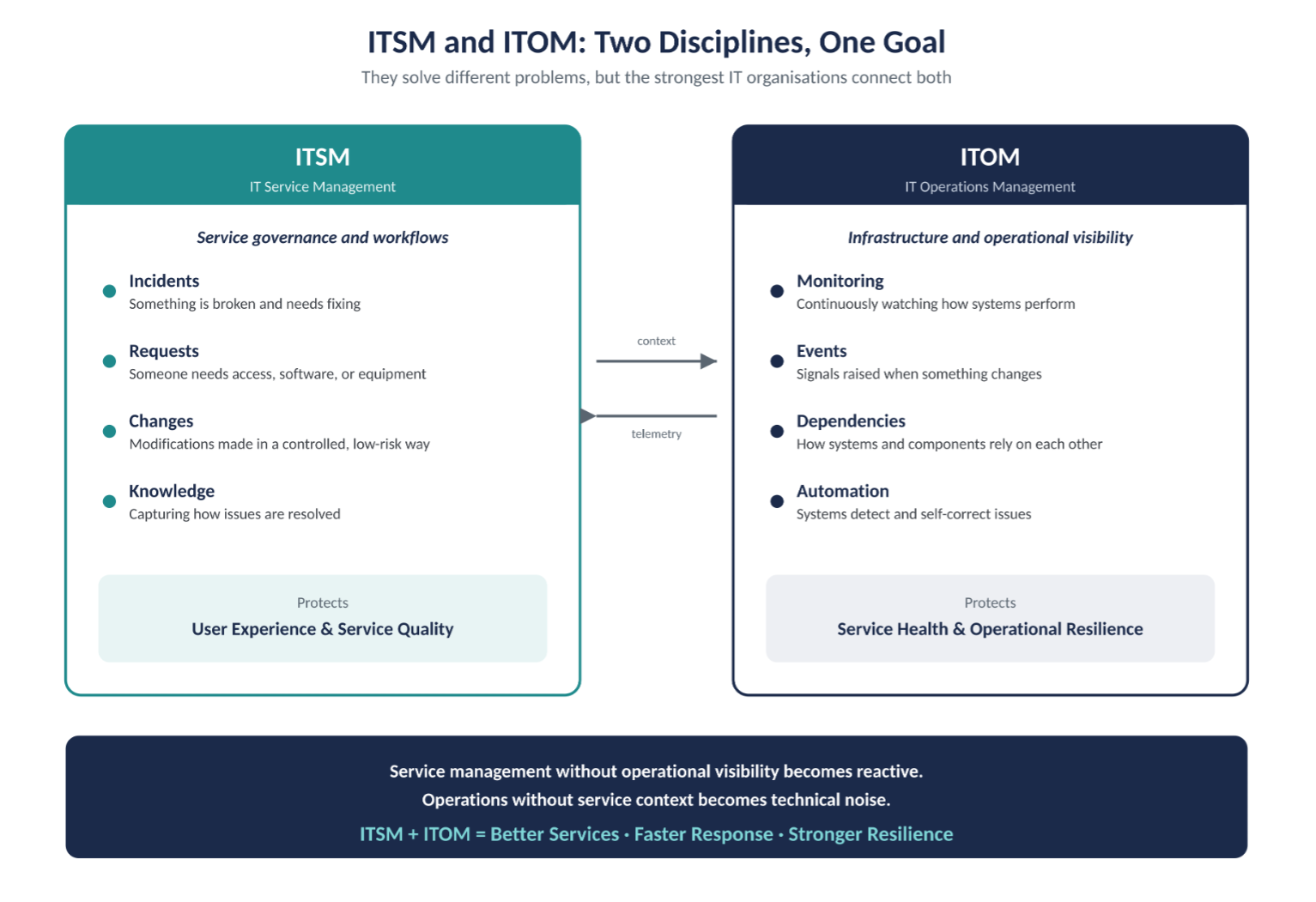
The diagram below brings the comparison to life - showing each discipline's focus, core activities, and what it protects, along with the flow of context and telemetry between them.
Why is there common confusion between ITOM & ITSM?
ITSM and ITOM are frequently confused because they sit so close together and often live inside the same platform or vendor suite. A monitoring alert raised by an ITOM tool, for example, may automatically create an incident in an ITSM tool. The disciplines hand work to one another constantly, which can make them look like a single process from the outside.
But the underlying purpose is different. ITSM asks: “Is the person being looked after, and is the process being followed correctly?” ITOM asks: “Is the technology actually working, and do we know about problems before they escalate?” An organisation can have excellent ITSM processes and still suffer outages if its ITOM capability is weak, and vice versa.
Why mature organisations connect both
ITSM and ITOM are not competing disciplines and should never be run as if one can substitute for the other. The most resilient, responsive IT organisations deliberately connect them, because each discipline is weaker without the other.
The connection in plain termsService management without operational visibility becomes reactive - issues are only known once a user reports them. Operations without service context becomes technical noise - alerts pile up with no clear link to business impact or priority. ITSM + ITOM together produce better services, faster response, and stronger resilience. |
When ITOM feeds real-time operational data into ITSM, incidents can be raised, prioritised, and routed automatically, often before a user is even aware of a problem. When ITSM feeds service and business context into ITOM, technical teams can see which alerts genuinely matter because they affect a critical service, rather than treating every signal as equally urgent. Together, the two disciplines turn IT from a function that reacts to complaints into one that anticipates and prevents them.
Summary
ITSM and ITOM solve different problems. ITSM governs how services are delivered and supported for the people who rely on them. ITOM keeps the technology underneath those services healthy and visible. They are not interchangeable, and neither one is a substitute for the other. But when they are connected, an organisation gains something greater than either discipline alone: services that are not only well managed, but genuinely resilient.